
This link will open in a new tab and lead to an external website. We are not responsible for its content or availability.
Micro-learning resource 1: Digital communication tools for collaboration
Theoretic section
The first Unit in this module has referred to how digital tool can facilitate the management from a business. In this section, communication tools for collaboration will be analysed more into depth.
Effective document management and seamless collaboration are key aspects for sustainable enterprises and eco-entrepreneurs who want to improve internal organisation and optimise teamwork. Having the right tools allows you to store, share and edit documents quickly and securely, avoiding wasted time and ensuring that information is always accessible to those who need it. There are both commercial solutions and FOSS (Free and Open-Source Software) alternatives on the market, each with specific features. The choice depends on the company's needs, the level of security required and the available budget.
Among the most popular commercial tools is Google Workspace, a cloud-based platform that includes applications such as Google Docs, Sheets and Drive. It offers real-time collaboration, centralised storage and an effective version control system, making it ideal for those looking for an intuitive and easily scalable solution. Another widely used option is Microsoft 365, which provides tools such as Word, Excel, SharePoint and OneDrive. It is particularly suitable for those enterprises that need advanced features, high security and integration with Microsoft Teams. Dropbox is also a popular solution, especially for small businesses that want a simple platform for reliable file storage and sharing, thanks to fast synchronisation and integrations with numerous apps.
For those who prefer open-source tools, there are viable alternatives that offer greater control over data. Nextcloud is a self-hosted platform that allows you to create your own private cloud, ideal for companies that place a high value on privacy and want to manage document storage directly. It offers file synchronisation, secure sharing and real-time collaboration. Another FOSS solution is LibreOffice Online, the web version of the LibreOffice suite, which allows collaborative document editing and is fully compatible with major Microsoft Office formats. It is a convenient choice for those looking for a free and open-source alternative to commercial solutions.
Here you can find a table summarising all the software described and they’re characteristics.
Supporting resource
Tool |
Type |
Key Features |
Best For |
Google Workspace |
Commercial |
Real-time collaboration, cloud storage, version control |
Companies looking for an easy-to-use, scalable, well-integrated solution |
Microsoft 365 |
Commercial |
Advanced document editing, high security, Teams integration, offline access |
SMEs needing professional tools and strong security |
Dropbox |
Commercial |
Simple cloud storage, file syncing, secure sharing |
Small businesses wanting a simple and reliable cloud solution |
Nextcloud |
FOSS |
Private cloud, file syncing, collaboration, strong data privacy |
Companies wanting data control and self-hosted solutions |
LibreOffice Online |
FOSS |
Online document editing, Microsoft Office compatibility, integration with self-hosted cloud |
SMEs looking for a free, open-source alternative |
Reflection time
Take your time to reflect: Have you ever used one of these tools? Would they be useful for your business?
6.2. Micro-learning resource 2: E-commerce options
Theoretic section
E-commerce refers to buying or selling goods and services online, whether the transactions occur between companies, households, individuals, or private organisations, using the internet or other digital communication networks (Eurostat, n.d.).
For sustainability-focused businesses, e-commerce creates valuable opportunities to connect with customers worldwide and showcase environmentally friendly and ethical products. Online selling platforms help small businesses build a digital presence, decreasing the need for physical storefronts and the environmental impact that comes with them. Below are some of the leading e-commerce platforms commonly used by small enterprises:
Shopify
A leading e-commerce platform that offers a comprehensive solution for creating online stores, managing inventory, and processing payments. It is a hosted, intuitive solution that simplifies the process for businesses of all sizes, and is ideal for those enterprises looking for an easy-to-use platform with extensive support and scalability.
WooCommerce
A flexible and customisable e-commerce plugin for WordPress, allowing users to create an online shop within their existing website. It is an open-source solution with a vast ecosystem of plugins and themes, ideal for businesses already using WordPress and those looking for a customisable and cost-effective solution.
Etsy
A marketplace for handmade, vintage, and unique products. It is ideal for crafters, artisans, and small businesses that focus on sustainability and ethical production.
Something fundamental to take into consideration when opening an e-commerce activity is the payment method. A secure and seamless payment process is essential for any online business. Integrating reliable digital payment solutions enables SMEs to offer customers a smooth shopping experience while ensuring data security and regulatory compliance. Below are some widely used payment gateways that can be integrated into e-commerce platforms. Three popular payment processing solutions, that can be seamslessy integrated into several e-commerce websites are: PayPal, Stripe and Square.
Following you can find the three e-commerce platform with their sustainable features.
Supporting resource
E-commerce platform |
Sustainable features |
Shopify: https://www.shopify.com/ |
|
WooCommerce: https://woocommerce.com/ |
|
Etsy: https://www.etsy.com/ |
|
6.3. Micro-learning resource 3: Emerging technologies for business
Theoretic section
Emerging digital technologies offer companies new opportunities to become more efficient, sustainable and transparent in their processes. In this Unit, we are going to explore some of them.
Artificial intelligence (AI) is a set of techniques that enables computers to perform tasks that normally require human intelligence, such as recognising images, understanding language or predicting future trends. Within AI, machine learning (ML) is a method that allows computer systems to learn from data and improve over time, without being programmed step by step. Thanks to these tools, companies can analyse large amounts of information, automate repetitive tasks and make faster and more accurate decisions, with positive effects on sustainability.
Blockchain, on the other hand, is a technology that stores data in a kind of distributed digital ledger that is shared and very difficult to modify. This feature makes it useful for ensuring transparency and traceability, for example to verify the origin of raw materials or ensure ethical sourcing practices.
The Internet of Things (IoT) refers to all those interconnected devices – such as sensors, machines or smart objects – that collect and exchange data in real time. In businesses, the IoT allows energy consumption to be monitored, environmental conditions to be controlled and the use of resources to be optimised, helping to reduce waste and costs. The integration of AI, ML, blockchain and IoT can therefore help businesses improve sustainability and efficiency in many areas.
However, these technologies also present significant challenges: the environmental impact of digital infrastructure, such as data centres; risks related to privacy and data security; ethical and social issues related to automation; possible economic effects on employment; and the risk of becoming overly dependent on complex and costly systems to maintain. Being aware of these opportunities and critical issues is essential for using digital technologies in a responsible and sustainable manner.
Supporting resource
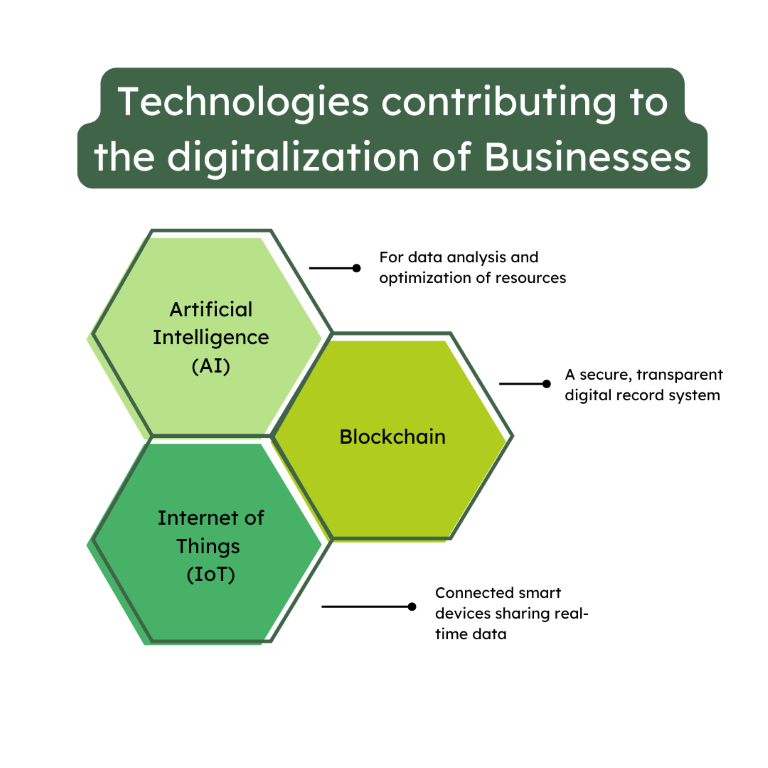
Concept inspired by https://philippsandner.medium.com/blockchain-iot-and-ai-a-perfect-fit-c863c0761b6
independent graphic reworking carried out as part of the Green New Home project.
Reflection time
Take your time to reflect on this question: do you see an application of one of these innovative digital tools in the future of your business? How?


