
This link will open in a new tab and lead to an external website. We are not responsible for its content or availability.
Micro-learning resource 1: Digital Tools for Sustainable Business Models
Theoretic section
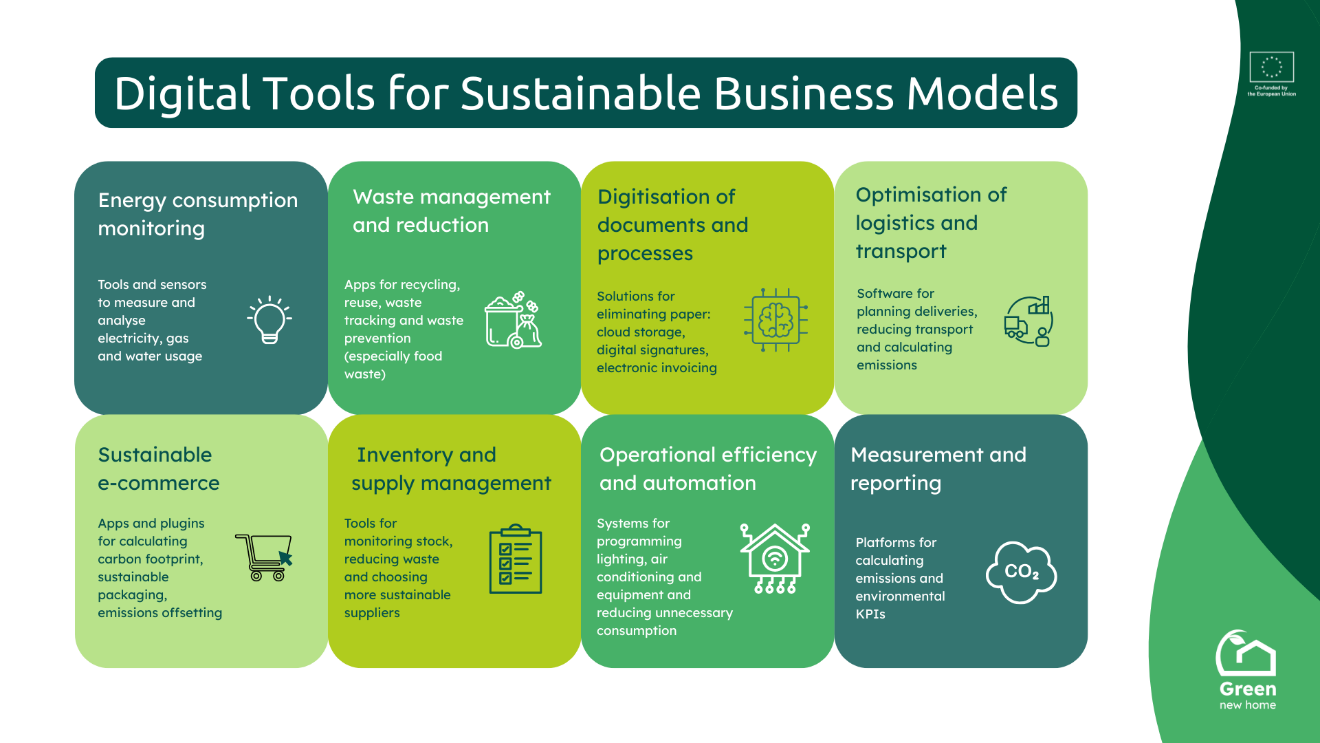
Digital tools are becoming increasingly essential for helping small businesses develop and implement sustainable strategies. While environmental pressures and consumer expectations tend to push businesses towards reducing waste and energy use, small entrepreneurs often see sustainability as expensive or complex. However, digital technologies can help overcome these barriers by providing affordable, accessible tools that make operations more efficient and waste less resources. Here is a list of digitalised processes that can help a business become more efficient while reducing its environmental impact:
Digital tools also enable new sustainable business models, including circular approaches, product-as-a-service, and repair or reuse practices. They lower costs, enhance customer engagement, and make sustainability a competitive advantage. Rather than replacing green efforts, digital tools strengthen them, allowing small businesses to innovate and transition toward more sustainable and resilient models.
Following there is an image describing all the areas in which digital tools support the application of sustainable business models.
Supporting resource
Please, take 5 minutes to ask yourself:
Write your answer in a word document or on the notes app in your phone, you can use this reflection as an inspiration for evolving your business.
2. Micro-learning resource 2: Measuring and tracking sustainability with digital tools
Theoretic section
Corporate sustainability has become an essential priority for today's businesses, and digital tools play a crucial role in monitoring and improving environmental impact. Dedicated software and platforms enable companies to track their carbon footprint, optimise energy consumption, manage waste and integrate big data analysis and artificial intelligence into strategic decisions. For example, ecological footprint calculators such as Footprint Manager, Greenly, or Microsoft Sustainability Manager allow companies to measure emissions across their entire supply chain, while intelligent energy management systems such as EcoStruxure or Energy & Utilities Analytics help identify inefficiencies and reduce waste. Similarly, waste management platforms enhance both transparency and efficiency in handling waste. Using these tools enables companies to set sustainability goals, monitor progress and comply with international standards, making sustainable practices a strategic and data-driven choice.
Next, we will explore some of the most popular digital tools that companies can use to measure and report on their sustainability goals, promoting a transparent approach focused on continuous improvement. The table below provides an overview of the main tools, with concrete examples and useful links for further information on their use.
Supporting resource
|
Category |
Tool |
Feature |
Link |
|
Ecological footprint calculators |
Website Carbon |
Measure the impact of your website and calculate CO₂ emissions |
|
|
Energy consumption dashboard |
EnergyStar Portfolio Manager |
Real-time monitoring, identification of inefficiencies, optimisation suggestions |
|
|
Software for drafting sustainability reports |
GRI (Global Reporting Initiative) |
International ESG reporting standards |
|
|
Eco-Act |
Carbon footprint monitoring and reporting in accordance with GRI and CDP standards |
||
|
Sustainable supply chain management |
SAP Ariba |
Monitoring supplier sustainability and responsible purchasing management |
|
|
Platforms for the circular economy |
Circular IQ |
Product life cycle management, recycling and reuse optimisation |
Reflection time
Explore the resources in the table, then reflect:
Write down your answer, it might become helpful later on.
3. Micro-learning resource 3: Digital tools to support circular economy practices
Theoretic section
Digital tools are essential for supporting the circular economy. They offer practical and affordable ways for businesses to make products last longer, reduce waste, and use materials more efficiently. In a circular model, value comes from keeping products and resources in use for as long as possible through reuse, repair, remanufacturing, and recycling. Digital technologies make these activities easier to start, manage, and expand-even for small businesses with limited budgets. For example, inventory and resource tracking tools help companies see what materials they already have, avoid unnecessary purchases, and reuse more. Repair and restoration platforms help extend product life, while online marketplaces for second-hand goods allow businesses to resell items that might otherwise be thrown away. Software for lifecycle management and digital twins also lets entrepreneurs test product performance, spot weak points, and design more durable products.
Online sharing platforms make another important contribution. They let many users access the same product or service, reducing the need for each person to buy new items. This supports new business models such as renting, leasing, or product-as-a-service. Mobile apps and cloud tools also make reverse logistics easier by helping businesses manage the return, repair, or recycling of products. Meanwhile, data analytics and IoT (Internet of Things) sensors give real-time information on energy use, waste, and material flows, helping companies see where improvements can be made (visit the last Unit of this Module for more information on these tools). With this data, businesses can make better decisions, cut inefficiencies, and show customers and partners how they are improving their environmental performance.
In the end, digital tools do more than support circular practices-they speed up the shift to a more resilient and regenerative economy. They help entrepreneurs innovate, reduce costs, and build business models that focus on long-term environmental value instead of short-term consumption.
Supporting resource
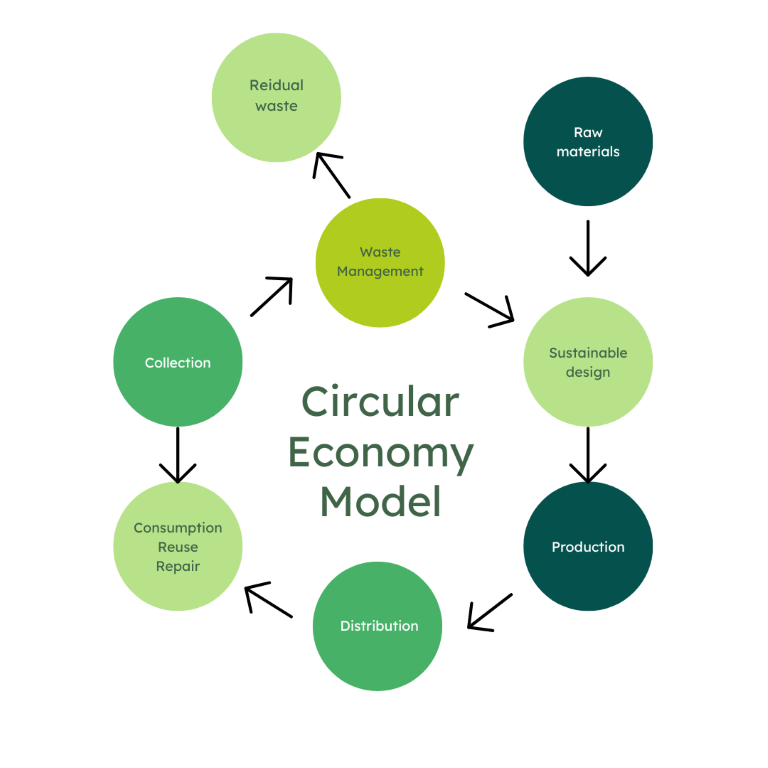
Concept inspired by https://www.europarl.europa.eu/topics/en/article/20151201STO05603/circular-economy-definition-importance-and-benefits independent graphic reworking carried out as part of the Green New Home project.


